


Summary
Thin-film lithium niobate (TFLN) refers both to a wafer structure—where a thin layer of lithium niobate is deposited on a silica and silicon substrate—and to an integrated photonics platform used to design compact, high-performance photonic circuits and components. This approach combines the exceptional electro-optic properties (and other nonlinear properties) of lithium niobate (LiNbO₃) with modern microfabrication capabilities based on nanometric or micrometric structures. As a result, it addresses critical requirements for bandwidth, energy efficiency, and integration driven by high-speed networks, data centers, and emerging technologies. This explains the growing interest from industry players and investors alike.
Fiber-optic communications are among the most transformative technologies of the past fifty years. They made the Internet, cloud services, and global connectivity possible, and today they support rapid growth driven by data centers, artificial intelligence (AI), and 5G and 6G networks. This evolution is placing increasing pressure on optical infrastructures, which must deliver ever greater bandwidth with improved energy efficiency and in increasingly compact form factors.
At the core of these systems are essential components—light sources, fibres, detectors, and especially optical modulators—that determine transmission rates and signal quality. Historically, the highest-performance modulators relied on lithium niobate crystals, a crystalline material capable of fast and linear electro-optic modulation through the Pockels effect. However, conventional bulk lithium niobate devices are bulky and difficult to integrate at scale. By contrast, thin-film lithium niobate confines the optical signal in such a way that modulation efficiency is increased by nearly a hundredfold compared with bulk crystals.
It is in this context that thin-film lithium niobate (TFLN) has emerged, bringing the proven performance of the material into a modern integrated photonics platform. This approach paves the way for compact, ultra-fast, and energy-efficient optical components suited to the demands of high-speed networks, data centers, and other emerging technologies.
What Is Thin-Film Lithium Niobate (TFLN / LNOI)?
TFLN, also known as LNOI (“Lithium Niobate on Insulator”), refers to a configuration in which a very thin layer of LiNbO₃ is bonded to an insulating substrate (typically SiO₂ on a support wafer such as silicon). This configuration enables the definition of nanophotonic waveguides with strong optical confinement and more efficient interaction between electric and optical fields than in conventional bulk optical structures.
This architectural shift opens the door to integrated photonics capable of achieving performance beyond that of discrete optical modules.
The material retains the exceptional properties of LiNbO₃: a strong electro-optic effect, significant nonlinear coefficients (χ²), and broad optical transparency, while enabling much more compact and manufacturable on-chip architectures.
Why Is TFLN Attracting So Much Attention Now?
Recent Technical Advances
Advances in nanofabrication now make it possible to produce very thin lithium niobate layers directly on industrial, commercially available wafers. This development enables the large-scale fabrication of photonic integrated circuits (PICs) without compromising optical quality or performance.
These advances translate into:
- Ultra-fast electro-optic modulators (bandwidths >100 GHz) with low drive voltage
- Improved energy efficiency and higher integration density of photonic components
- Active and nonlinear structures leveraging the strong χ² nonlinearity for advanced functions such as frequency conversion, frequency comb generation, and photon-pair generation
These performances often surpass those of conventional bulk LiNbO₃ modulators and meet the increasing demands of modern optical systems.
Market Drivers
From a market perspective, TFLN is still at a relatively early stage, but it builds on a well-established technological foundation. The global market for lithium niobate modulators and high-performance optical components already represents billions of dollars, while integrated photonics continues to grow steadily.
Although the current market for TFLN wafers and devices remains modest, its growth trajectory is clearly positive, driven by increasing demand for next-generation telecommunications and data transmission systems.
Market reports project significant growth in revenues for TFLN modulators, with double-digit compound annual growth rates and valuations expected to exceed USD 1 billion by the end of the decade.
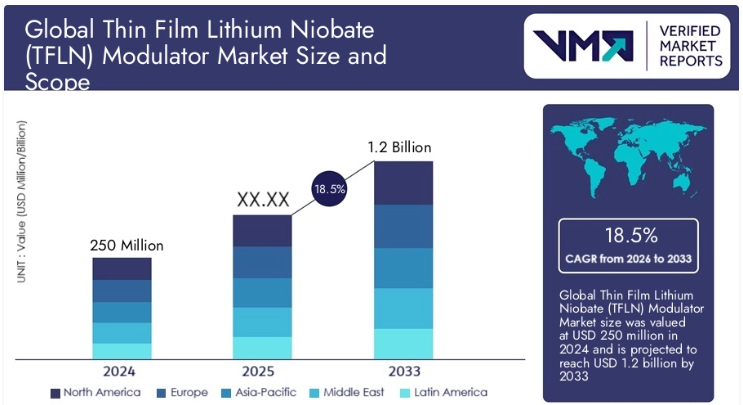
Source : Thin Film Lithium Niobate (TFLN) Modulator Market Size, Industry SWOT & Forecast
This momentum is attracting significant investment from optical equipment manufacturers, system integrators, and technology funds, as TFLN promises to reduce the cost per bit while improving the energy efficiency of networks. Energy consumption is increasingly discussed in joules per bit (energy per unit of information) to quantify efficiency in the telecommunications industry.
Key Use Cases
Telecommunications and Data Centers
In telecommunications networks and data centers, the efficiency and bandwidth of electro-optic modulators determine the capacity to transmit data at very high speeds. The TFLN platform enables the development of more compact modulators with lower energy consumption per transmitted bit and reduced thermal losses.
This helps lower operational expenditures (OPEX) while increasing the available bandwidth for operators and large cloud data center providers (hyperscalers) such as Amazon, Microsoft, Google, and Meta.
Emerging Technologies
TFLN also enables the design of optical components that directly address the needs of modern infrastructures:
- Coherent transmission, where the linearity and speed of modulators improve system performance
- Quantum photonics and metrology, leveraging the strong nonlinear properties and compact integration offered by TFLN
- Advanced sensors and LiDAR applications, benefiting from a broad optical spectrum and chip-scale integration .
These applications open new high-growth segments and clearly link the technology to measurable benefits for innovative companies.
Alternatives to TFLN
Several photonic platforms coexist today, each offering specific advantages as well as limitations.
- Silicon photonics stands out for its high level of integration and industrial maturity but is constrained by a weak intrinsic electro-optic effect.
- Silicon nitride offers extremely low optical losses but does not support native active modulation.
- III–V materials provide optical gain essential for certain applications, though at the cost of higher complexity and expense.
- Bulk lithium niobate remains a benchmark for electro-optic performance, but its larger form factor limits its integration potential in systems and subsystems.
Within this landscape, TFLN positions itself as a synthesis of the main advantages of these platforms—integrability, performance, and energy efficiency—while still facing challenges related to fabrication and photonic packaging.
Current Challenges and Limitations
Despite its strong potential, TFLN still faces several industrial challenges. Manufacturing costs remain higher than those of some alternative platforms, while wafer uniformity and the maturity of large-scale production processes are still evolving.
Additional challenges relate to packaging and testing, which require dedicated innovations to ensure the robustness and reliability of systems. Addressing these factors will be critical for large-scale adoption, particularly in markets that are highly cost-sensitive.
Conclusion
In this context, TFLN is emerging as a transformative evolution in integrated photonics, addressing critical needs for energy efficiency, bandwidth, and integration.
To fully leverage this technology, organizations must be able to evaluate technological trade-offs, prototype rapidly, and validate performance at the wafer level.
With its photonics microfabrication capabilities and dedicated TFLN foundry processes, INO supports companies and innovation teams at this key stage—between technology exploration and preparation for industrialization.
Let’s discuss your photonic project
Are you developing a TFLN photonic circuit or exploring new photonic architectures?
Our teams can help you identify the most suitable technological approaches and collaboration models for your project.
