Far-infrared (FIR, 15–1000 µm) observations are essential for measuring Earth’s radiative budget, characterizing thin ice clouds, analyzing aerosols, and interpreting the thermal signatures of planetary surfaces. INO offers ultra-broadband detectors based on black-gold absorption technology, providing exceptional sensitivity from the FIR to the terahertz range.
This application note presents:
- Key scientific applications of FIR
- Detection challenges at these wavelengths
- Current technologies (thermopiles, bolometers, microbolometers)
- Performance of INO’s next-generation detectors qualified for space missions
Download the application note to access technical details, case studies, and complete performance data.
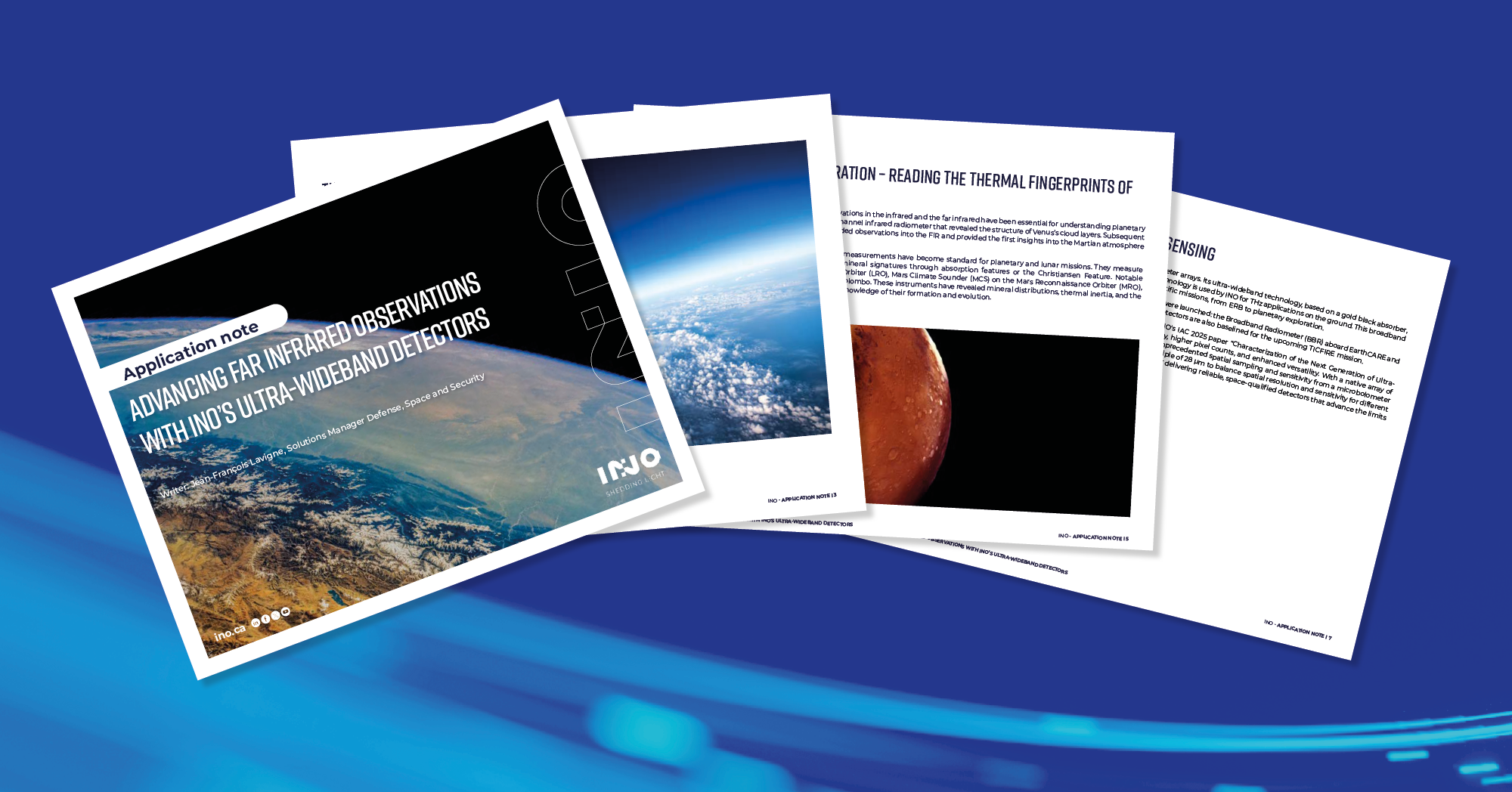
Pushing the Limits of FIR Observation with INO’s Black-Gold Technology
Far infrared (15 to 1000 µm) is a critical spectral region for understanding radiative exchanges, characterizing ice clouds, analyzing aerosols, mapping planetary minerals, and measuring the thermal inertia of lunar surfaces.
But accessing this spectrum requires detectors that are highly sensitive, robust, and capable of operating in extreme environments.
Why FIR Is Essential for Earth Science and Planetary Exploration
FIR complements traditional infrared measurements by providing unique sensitivity to radiative processes, ice-phase transitions, and surface thermal signatures.
In the application note, you’ll learn how FIR measurements help:
- Improve the accuracy of climate models
- Reveal the microphysics of ice clouds
- Analyze high-altitude aerosols
- Characterize the surfaces of Mars, the Moon, and other planetary bodies
Thermopiles, Bolometers, Microbolometers: Which FIR Technology to Choose
The application note provides a detailed technical comparison of currently used detectors:
- Thermopiles
- Uncooled microbolometers
- Ultra-sensitive cryogenic bolometers
You’ll understand which technology best suits each mission type — and why.
Ultra-Broadband Detectors: How INO Is Redefining FIR Sensing
For more than 35 years, INO has developed broadband microbolometers using black-gold absorbers that offer:
- Exceptional spectral response from the FIR to the terahertz range
- High thermal stability
- Compact, lightweight arrays for space missions
- Strong environmental resilience
What You’ll Learn in the Application Note
- Why FIR (15–1000 µm) is essential to understanding Earth’s radiative processes
- How thin ice clouds influence climate, and why only FIR can characterize them accurately
- Which space missions depend on FIR detectors today
- Comparative advantages of thermopiles, bolometers, and microbolometers
- How INO’s technology enables unique ultra-broadband detection
Technical Level

Frequently Asked Questions
What is the far infrared (FIR)?
FIR covers wavelengths from 15 to 1000 µm and enables the observation of thermal fluxes, ice clouds, aerosols, and mineralogical signatures of planetary surfaces.
Why is FIR difficult to observe?
Because water vapour and CO₂ strongly absorb this radiation, requiring space-based, stratospheric, or high-altitude platforms.
What types of detectors are used in the FIR?
Thermopiles, cryogenic bolometers, and uncooled microbolometers — each optimized for specific mission needs.
What makes INO’s detectors unique?
Their black-gold absorber, which provides ultra-broadband spectral response from UV to FIR and up to the terahertz range, with high sensitivity.
Which missions use INO detectors?
INO detectors are found aboard EarthCARE, the Lunar Trailblazer mission, TICFIRE, and several past and upcoming FIR/LWIR instruments.