Summary
This application note outlines the importance of polarization extinction in space-based QKD systems and its direct impact on QBER and secure key generation. It also highlights optical architectures designed to maintain high performance in space environments.
Achieving Ultra-High Polarization Extinction for Space-Based Quantum Communication
As space infrastructure evolves, optical communications are becoming a strategic solution for secure links between Earth and orbit. In this context, quantum key distribution (QKD) is emerging as a key technology to protect communications against current and future threats.
For QKD systems, optical performance must exceed conventional standards. Polarization state separation is critical, as it directly impacts the quantum bit error rate (QBER) and the ability to generate secure keys.
This application note presents:
- Optical communications and QKD for secure space links
- The role of polarization in QKD performance
- The impact of polarization extinction on QBER
- Optical architectures designed for space environments
Download the application note to learn how ultra-high polarization extinction enables secure quantum communication.
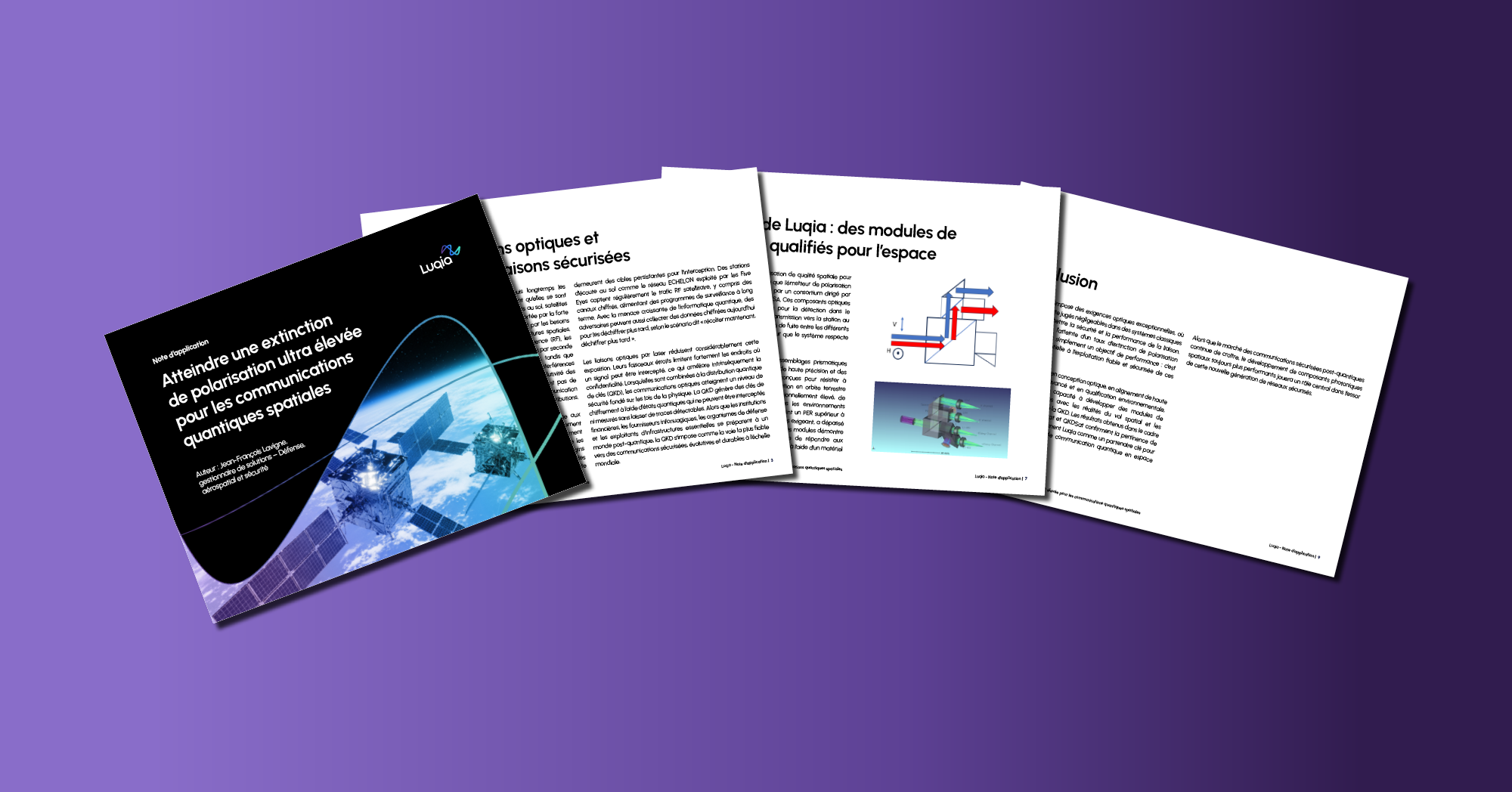
Space-Qualified Polarization Modules
Luqia has developed polarization modules for space-based QKD systems, including the QEYSSat receiver and QKDSat transmitter.
These systems use monolithic prism assemblies, high-precision bonding, and robust opto-mechanical design to maintain high polarization extinction in space conditions.
Performance:
- PER > 430 (QEYSSat)
- PER > 3400 (QKDSat)
What You’ll Learn
- How polarization impacts QKD performance
- Why high polarization extinction is required
- How optical systems maintain performance in space
Technical Level

Frequently Asked Questions
What is QKD?
Quantum key distribution is a method for generating encryption keys using quantum states of light. Because the key information is carried by quantum states, any attempt to intercept or measure the signal introduces detectable disturbances, allowing the communicating parties to verify the security of the link.
Why is polarization important?
In many QKD protocols, information is encoded in the polarization of photons. Accurate separation of these polarization states is essential, as any mixing or leakage directly increases the quantum bit error rate (QBER) and reduces the system’s ability to generate secure keys.
What is PER?
The polarization extinction ratio (PER) measures how effectively an optical system separates polarization channels. Higher PER corresponds to lower leakage between channels, which is critical in QKD systems where even small errors can impact security and performance.